A speedy post about the 16 legs of Blackface mutton arriving in the shops tomorrow, Friday 31st May. From three to five year old Blackface cull ewes, the meat is quite lean but incredibly tasty - with all that time grazing out on the North Yorks Moors, these legs are very robust and flavoursome, almost herbal due to a diet rich in heather and gorse. A long, slow braise or pot roast with plenty of stock vegetables and liquid is ideal (like us, older mutton needs a bottle of wine or beer for company, otherwise it could be a bit dry and tough). The shoulders and breasts went into our pies, sausages and sausage rolls, so they'll be extra-tasty this weekend too.
We'll have a few legs in each shop tomorrow - first come, first served, a rare treat not to be missed.
Thursday, 30 May 2013

Monday, 20 May 2013
Farmhouse Cook Book - a party!
On Thursday we took a day out of the serious world of farming and butchery to throw a party to celebrate our new book. And celebrate we did, with pies, platters of ham, chutneys galore and a river of top notch booze. If you fancy starting a curing project, getting knee deep in homemade chutney or expanding your roast repertoire, you can pop into our shops and pick up a copy for £16.25 (RRP £25 - the difference should be enough to make your first kilo of streaky bacon).
Huge thanks to everyone involved in the party, but especially to...
Oval Space for letting us bring a touch of the countryside to their edgy East London events space (we've never felt so hip), and Bash Redford of Forza Win for making sure that everything went according to plan.
Our three utterly fantastic drinks sponsors, Hush Heath, Sambrook's Brewery and Penfolds Estate (via Treasury Wine Estates) - we go to great lengths to ensure that everything we produce is as good as can be, and it was a delight to work with three businesses who do the same. Cheers!
And last but not least to the brilliant team at Octopus, publisher of the book, who along with Fran Warde and her wonderful recipes, worked really hard to make this book happen.
 |
| The book. |
 |
| Hush Heath's single estate, Champagne-method cider |
 |
| Ceremonial pie! 'Ginger Pig Farmhouse Cook book' |

 |
| Notoriously camera shy Tim Wilson slicing the pie. |
 |
| Penfolds Koonunga Hill 2010 Shiraz and Riesling, Sambook's Wandle and Powerhouse Porter |
 |
| Love Food's Andrew Webb, showing us how to eat Colston Bassett Stilton |


 |
| Claire of fantastic new Hackney restaurant, Mayfields, sporting a rather fitting brooch |
 |
| Powerhouse Porter, right at home on the cheeseboard |

 |
| Wandle and sausage rolls...perfect match! |
 |
| And finally, our Creative Food Director, Nicola, doing what she does best - getting everyone tipsy. |
Tuesday, 7 May 2013
Ginger Pig Farmhouse Cook Book - out today!
Say hello to our new book!
 Where our 2011 Meat Book focused on just that - how we farm and recipes to make the most of meat, set within a year on Grange Farm - the Farmhouse Cook Book is a broader look at everything we do, brought together beautifully with a new collection of Fran Warde's wonderful recipes.
Because we're not just a company of farmers and butchers - what we do is wider than that. There's the arable land in which we grow crops to feed our animals, and the edible berries, brambles and leaves to be picked in the hedgerows that surround it. In our preserving kitchen you'll find Julie and Rachel, who work four days a week to produce lip-smacking chutneys, jellies, jams and pickles, using as much homegrown and local produce as possible. The bakery and kitchen up at the farm is where our sausage rolls, pies, hams and other cured meats are prepared ready for the shops, and this is as much a part of the Ginger Pig as a slab of beef or a massive pork chop. Open the pantry in Tim's kitchen and if you're lucky you'll find bottles of last year's sloe gin and a cake primed for elevenses...

The Farmhouse Cook Book brings all of this together along with a little bit of rural history, with chapters on curing, casseroling, foraging, roasting, preserve making, puddings and making the most of the veg garden. It's not simply aimed at cooks who have a host of fresh produce on their doorstep, but at giving a bit of encouragement and instruction to anyone who wants to have a go at making more of their ingredients from scratch. We don't expect you to run out and buy a pig (that's still our job!), but making your own streaky bacon is a fairly easy curing project - and well worth a go if you're even slightly interested.
A speedy thanks to all at Mitchell Beazley for their hard work, to Kristen Perers and Pene Parker for making it all look so beautiful, and - of course - to Fran, for writing us a collection of scrumptious recipes to supplement some old Ginger Pig favourites.
We hope readers will enjoy cooking from the Farmhouse Cook Book for years to come.
Friday, 26 April 2013
A fond farewell
Today marks the end of an era at the Ginger Pig, as we say a very fond and slightly teary farewell to office manager David, leaving us today after more than five years of service. It's hard to put our sentiments into words without underselling him or sounding cheesy, so we'll just say that David has been a very large part of the quiet glue that sticks everything in place here. He'll be sorely missed - both for his cheerful demeanour and for his hard work and dedication, though we are wondering whether he can yet tell the difference between a lamb chop and a leg steak :-)
Here he is - probably his career highlight - with the lovely Gizzi Erskine at his side.

Good luck, David!
Tuesday, 23 April 2013
Shopping spree
Saturday April the 20th was the 2013 Spring and Summer Longhorn Cattle Society show and sale, and we had our sights set on two prize heifers - young females, intended for breeding. But before we get to the show we'll go back to the beginning; spring 2012, when our prize bull, Dynamo, sired the most fantastic bull calf we have ever seen.
Dynamo is quite the legend on the farm, and at over 1,000kg he's an animal you definitely don't want in a China shop (or anywhere but a farm, behind a sturdy fence or gate). We periodically buy new Longhorn bulls - majestic males, our fantastic breeding stock - in order to keep the herd bloodlines nice and clear; we need to retain the characteristics and purity of the Longhorn breed, while ensuring that we're not diminishing the gene pool by inbreeding. So with a new bull - full of his father genes - we need to look outside of our own herd for mating females, which is what brought us to the show this Saturday.
Our visit to the show didn't quite go to plan - but we've all done it, haven't we? You go in for some sausages and come out with steaks; a lunchtime browse around the internet leads to two pairs of jeans and some shoes or a holiday in Prague - it's easy to get carried away. Boss man Tim, who has never much cared for jeans or Prague, arrived at the show with his eye on two fantastic heifers, but came home with...wait for it...twelve. This year was one of unprecedented quality, and if there's one thing Tim has learned, it is that you buy good livestock when you see it.
So we welcome twelve fine females to begin a whole new herd; may their lives with us be long and happy (and our bank manager soon forgive us).
Newton Wine Gum
Tanfield Lace
Tanfield Munchkin
Tanfield Medlar
Tanfield Martini
Kedleston Lupin
Kedleston Laburnum
Kedleston Maisie
Kedleston Miranda
Kedleston Mahonia
Nobut Willow
Courthayes Mahonia
 |
| Dynamo |
Dynamo is quite the legend on the farm, and at over 1,000kg he's an animal you definitely don't want in a China shop (or anywhere but a farm, behind a sturdy fence or gate). We periodically buy new Longhorn bulls - majestic males, our fantastic breeding stock - in order to keep the herd bloodlines nice and clear; we need to retain the characteristics and purity of the Longhorn breed, while ensuring that we're not diminishing the gene pool by inbreeding. So with a new bull - full of his father genes - we need to look outside of our own herd for mating females, which is what brought us to the show this Saturday.
 |
| One of our mature cows |
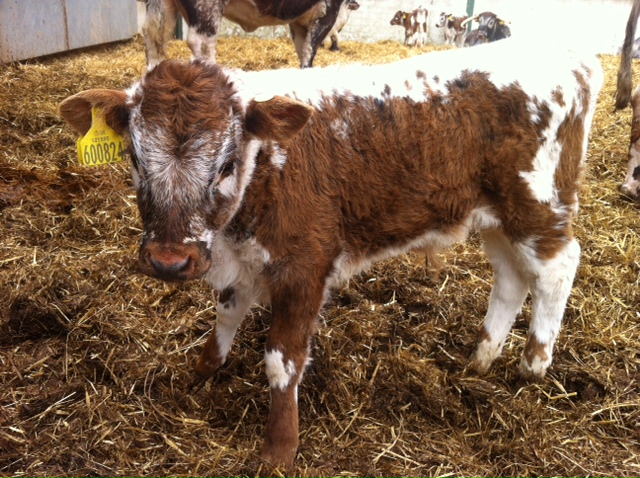 |
| Newly minted Longhorn calf |
Our visit to the show didn't quite go to plan - but we've all done it, haven't we? You go in for some sausages and come out with steaks; a lunchtime browse around the internet leads to two pairs of jeans and some shoes or a holiday in Prague - it's easy to get carried away. Boss man Tim, who has never much cared for jeans or Prague, arrived at the show with his eye on two fantastic heifers, but came home with...wait for it...twelve. This year was one of unprecedented quality, and if there's one thing Tim has learned, it is that you buy good livestock when you see it.
 |
| A selection of our new girls |
Newton Wine Gum
Tanfield Lace
Tanfield Munchkin
Tanfield Medlar
Tanfield Martini
Kedleston Lupin
Kedleston Laburnum
Kedleston Maisie
Kedleston Miranda
Kedleston Mahonia
Nobut Willow
Courthayes Mahonia
Monday, 25 March 2013
New season Dorset lamb
While lamb and Easter have become as inseparable as fish and chips, spring lamb - a surprisingly delicate meat - is easily (and often) abused with powerful, overwhelming flavours. It's also, with such an early Easter this year, going to be in relatively limited supply; here's how you go about reserving some and how to make the most it.


The only breed that will produce lamb naturally in time for spring meat is the woolly Dorset (above). Our ewes lamb in early December, and so new season lamb feeds almost exclusively on mother's milk, as there are slim pickings on the ground during winter time. As a result it doesn't develop the huge, bold flavours you get with the late summer animals and winter hogget, but instead has a beautifully soft and delicate texture and flavour, which is one of the finest treats of spring.
Where you might otherwise cook lamb with rosemary, garlic, anchovies, capers and peppers, exercise restraint with spring meat and reach for what is in season at this time of year - wild garlic, kale, leeks, spring onions, purple sprouting broccoli and spinach. We're a little bit early for English asparagus and Jersey Royals just yet, but when you spy some, they're a perfect match. If you're looking for something to fill your glass, a good quality white Rioja or a light red such as a gamay would do the trick.
Legs should be served a little pink, while shoulders still need long and slow cooking in order to tenderise. Both benefit from a longish rest, so wrap them in foil and throw over a bath towel (top tip!) to keep the heat in while side dishes are finished and glasses topped up.
Pre-ordering
Due to the popularity of legs of lamb, you might want to order one in advance. You can place an order by visiting your nearest Ginger Pig shop, or call the farm on 01751 460091, Monday 25th - Thursday 28th March, 9am - 5pm and speak to a member of the head office team. All other cuts should be available, though you can pre-order if there's a something you particularly want to guarantee. If you can, please try not to call your shop to order, as they don't have the facilities to take an order over the phone.
Easter opening hours
Our shops are open as usual, except on Easter Sunday and Bank Holiday Monday, when they are all closed (and we'll be having a nice rest!).
Friday, 15 March 2013
Spring chickens
Our Askew Road butcher Tom has been driving to Paris every week for over a year, to deliver beef to a butcher and restaurant and bring back French poultry and Limousin veal. While there are certainly some great British birds to be proud of - and we sell a couple of very fine examples - there's a lot of specialism and variety to be had from French poultry, and we're proud to be one of the few stockists in the country.

From left to right (excuse the slightly blurry pic!) we've got:
Canette de Barbarie
Neat little Barbarie ducklings which will serve 2-3 people. Full flavoured with a bit of game about them, comparatively lean but incredibly tender if given the right care and attention in the kitchen. Although they roast well, they're absolutely superb pot-roasted; roughly chop some fennel and carrots, and add to a heavy pot with peeled shallots, garlic cloves and a couple of halved plums. Add a couple of bay leaves, cinnamon sticks and star anise, and season with salt and pepper. Add 100ml water, cover and roast at 160°C, basting every half an hour or so, for two hours or until the juices run clear. Serve with rice or potatoes and greens - and as you carve the duck (it should be amazingly tender), remove the skin and pop it in a hot oven for 10 minutes to make duck scratchings.
La pintade de Challans
Or heritage breed guinea fowl to us. They're a slow-growing breed which reach maturity at about 13 weeks - more than twice what some poor chickens are given. They graze and peck at grain, grass and herbage, which you can really taste in the meat. Definitely recommend pot-roasting these as they're quite lean; a few stock vegetables, aromatics and herbs, a large glass of wine (in the pot!) and a slow roast with the lid on. From the Challans region, from farmers who are certified to rear to the exacting standards above.
Poulet fermiere de Landes (top centre, red label)
"Chicken farms of Landes" - another region known for its fantastic approach to poultry rearing, with a Label Rouge stamp of of quality. These birds are a fairly leggy, corn fed variety, producing rich, tender and juicy meat. Again, reared outdoors and slow growing, these chickens have a bit more fat to them than you might expect and benefit from roasting a little lower and slower than you usually would.
Poulet noir du Gers
Another Label Rouge bird, easily recognised by their distinctive black legs and feet. The primary choice in many top French brasseries - a little leaner perhaps than the Landes chicken but still has bags of succulence and flavour. As with all Label Rouge birds, completely free range and matured to a minimum of 81 days (a good twenty days more than some free rangers over here), and hung guts in to make a good, tasty chook.
Coquelet
Just as the name suggests, a little chicken - ideal for one or two people. Roast, pot roast, or poach - a versatile and tasty little bird.
We do sell much more British chicken than French, and - as ever - are committed to the best in British farming. But these offer something a little different and a lot delicious - we hope you'll give one a try over the weekend.
Subscribe to:
Posts (Atom)